
Studying overseas is an exciting opportunity for Indian students, but tuition fees and living expenses…
Choosing the right English proficiency test is an important step for students planning to study abroad. IELTS and PTE are both widely accepted by universities and institutions across major destinations, but their formats, scoring systems, speaking assessments, and preparation styles are different. The better option depends on your destination, university requirements, personal strengths, and application timeline.
IELTS vs PTE: Key Differences
Both exams assess Listening, Reading, Writing, and Speaking, but they use different testing approaches.
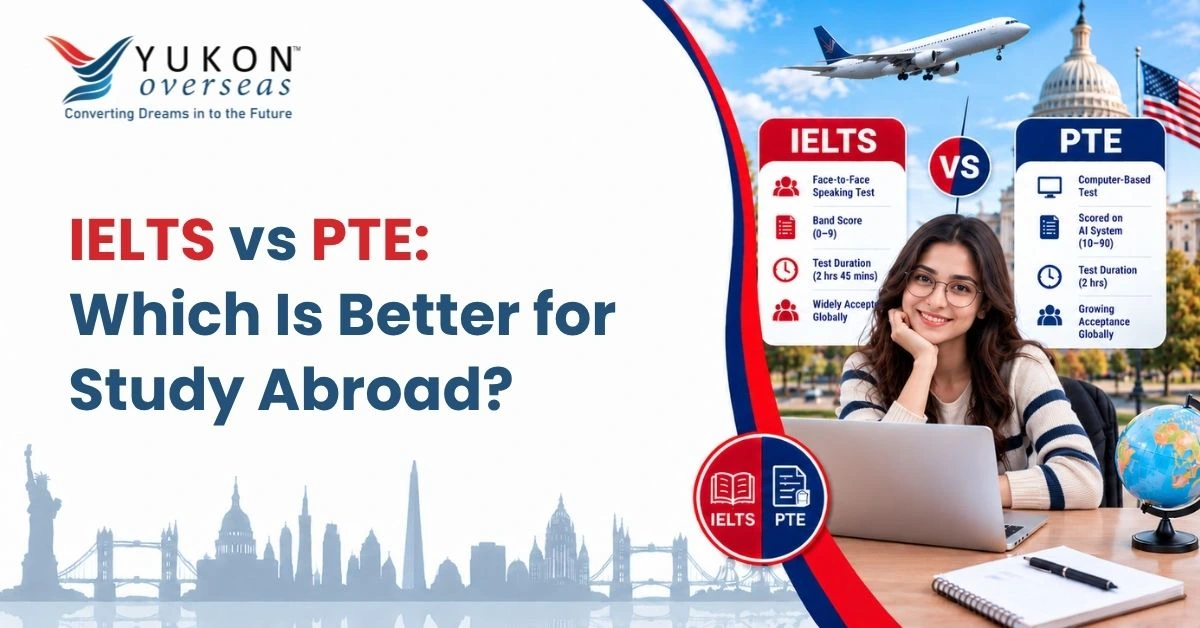
| Feature | IELTS Academic | PTE Academic |
| Test Format | Paper-based or computer-delivered | Fully computer-based |
| Speaking | Face-to-face with an examiner | Recorded through a microphone |
| Scoring | 0–9 band scale | 10–90 point scale |
| Duration | Around 2 hours 45 minutes | Around 2 hours |
| Results | Usually available within a few days | Often available within a few days |
| Validity | Typically 2 years | Typically 2 years |
Understanding these differences can help you identify whether IELTS or PTE better matches your preferred way of taking an English proficiency test.
IELTS Exam Format and Assessment
IELTS Academic evaluates four language skills through separate sections. Listening includes four recordings, Reading contains three passages, Writing includes two tasks, and Speaking involves a direct conversation with an examiner.
The Speaking test is one of the major differences between IELTS and PTE. Candidates who are comfortable communicating naturally with a person may prefer the IELTS format. The test also uses a band scale from 0 to 9, with scores reported for individual skills as well as an overall result.
PTE Exam Format and Assessment
PTE Academic is entirely computer-based and combines different language skills across its tasks. The Speaking & Writing section includes tasks such as Read Aloud, Repeat Sentence, Describe Image, Summarize Written Text, and Essay Writing.
For students comparing IELTS with PTE, the computer-based format can be an important consideration. Speaking responses are recorded through a microphone and assessed through automated scoring technology. Students who are comfortable with computers, typing, and speaking into a microphone may find this format suitable.
Planning to study abroad and unsure which English test to choose? Contact us for guidance on IELTS, PTE, preparation, and study-abroad requirements.
IELTS vs PTE: Which Is Easier?
There is no universally easier test. Your performance can depend heavily on your communication style and familiarity with the exam format.
IELTS may suit you if:
- You are comfortable speaking with a human examiner.
- You prefer clearly separated test sections.
- You are confident with descriptive and essay writing.
- You prefer a traditional assessment environment.
PTE may suit you if:
- You are comfortable taking a fully computer-based test.
- You prefer speaking into a microphone.
- You have good typing speed.
- You are comfortable with rapid computer-based tasks.
- You want potentially faster results.
Instead of choosing based only on perceived difficulty, compare both formats and identify where your strengths are strongest.
Acceptance for Study Abroad and Student Visas
Both IELTS and PTE are accepted by many universities and institutions across destinations such as the UK, Australia, Canada, New Zealand, Ireland, and the USA. However, acceptance can vary by university, course, and visa route.
Students should always check the exact English-language requirement for their chosen institution and destination before booking a test. UK applicants should also pay attention to whether a specific UKVI-approved version is required for their visa route.
IELTS vs PTE: Cost, Results and Validity
Test fees can vary by country, test centre, and date, so applicants should verify the current fee before registration. Both exams are generally valid for two years.
Result timing can also influence your decision. PTE is known for relatively quick result processing, while IELTS result availability depends on the test format. Students applying close to university deadlines should consider the complete timeline, including preparation, test availability, results, and possible retakes.
How to Choose Between IELTS and PTE
The right choice should be based on more than popularity. First, check whether your target university and visa route accept the test. Then consider your preferred speaking environment, computer skills, writing ability, preparation style, and application deadline.
If you are still uncertain between IELTS and PTE, taking practice tests for both can help you understand which format feels more natural. Your initial performance can provide a useful indication of where additional preparation may be most effective.
Frequently Asked Questions
Neither test is universally better. The right choice depends on your destination, university requirements, visa route, test-taking strengths, and preferred exam format.
Neither PTE nor IELTS is automatically easier. Students who are comfortable with computers and microphone-based speaking may prefer PTE, while those who prefer speaking with an examiner may find IELTS more suitable.
Many universities accept both exams, but requirements vary by institution, programme, and destination. Always verify the requirement of your chosen university before registering.
The major differences include the test format and Speaking assessment. IELTS can be paper-based or computer-delivered and uses a human examiner for Speaking, while PTE is fully computer-based with recorded speaking responses.
Check your university and visa requirements first, then consider your speaking preference, computer skills, preparation style, and application timeline. Practice tests for both can help you make a more informed decision.
Conclusion
The choice between IELTS and PTE ultimately depends on your individual study-abroad plans. IELTS can be suitable for students who prefer human interaction and a traditional test structure, while PTE can appeal to students who prefer a fully digital examination and computer-based assessment. Before registering, compare your destination, university requirements, visa rules, strengths, and timeline to choose the test that best supports your international education goals.
Related Posts