
Studying overseas is an exciting opportunity for Indian students, but tuition fees and living expenses…
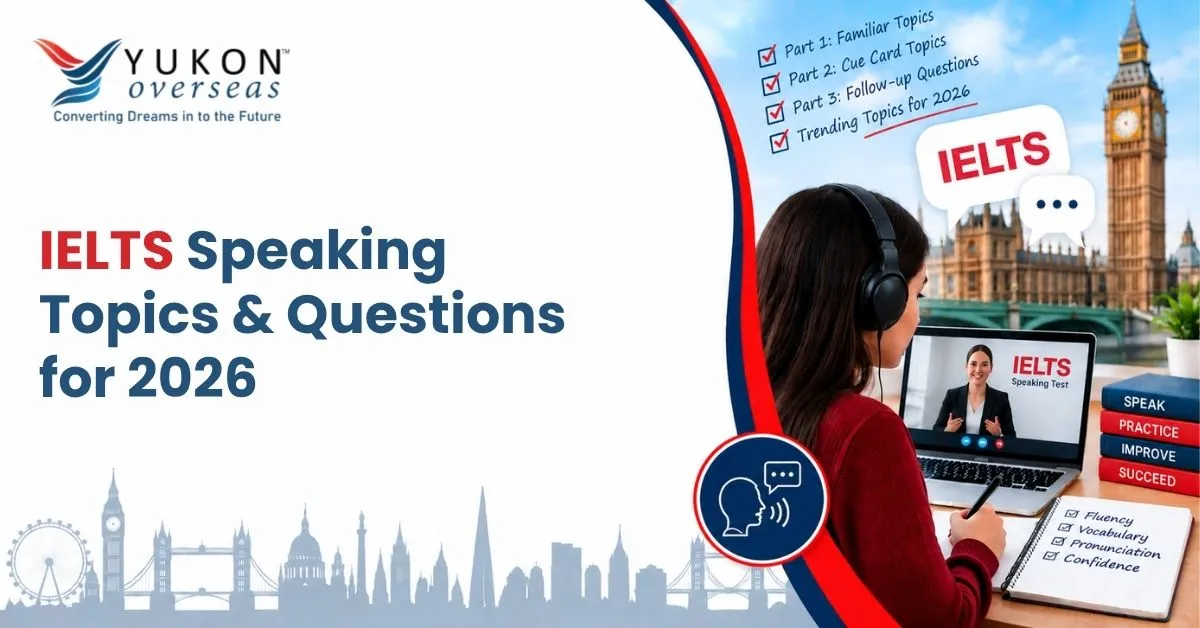
The IELTS Speaking test is a face-to-face assessment of your ability to communicate clearly and naturally in English. It lasts around 11–14 minutes and is divided into three parts: an introduction and interview, an individual long turn, and a two-way discussion.
For students preparing for the 2026 test, understanding the latest IELTS Speaking Topics 2026 can make practice more focused. However, preparing a few memorised answers is not enough. The examiner can change the wording, ask follow-up questions, or introduce a familiar topic from a different angle.
The best preparation combines knowledge of common themes with flexible speaking skills. Students should practise expressing personal experiences, describing situations, explaining opinions, comparing ideas, and supporting their answers with relevant examples.
IELTS Speaking Test Format
The three parts of the Speaking test assess different communication abilities. Understanding the structure of IELTS Speaking Questions 2026 helps students practise the appropriate response style for each part.
| Part | Duration | Main Focus | Format |
| Part 1 | 4–5 minutes | Personal and everyday topics | Short questions across different themes |
| Part 2 | 3–4 minutes | Individual long turn | 1 minute preparation and 1–2 minutes speaking |
| Part 3 | 4–5 minutes | Abstract discussion | Follow-up questions linked to broader issues |
Knowing this structure helps you practise according to the type of response expected in each section.
IELTS Speaking Part 1: Common Topics for 2026
Part 1 begins with familiar subjects related to everyday life. IELTS Speaking Topics for this section commonly include personal experiences, routines, interests, work, studies, and familiar surroundings. The questions are generally straightforward, but answers should still be developed naturally rather than limited to one-word responses.
Work or Studies
Questions may focus on your current studies, job, subject, daily routine, or future plans.
For example:
- What do you study?
- Why did you choose your subject?
- What do you enjoy most about your studies?
- What are your future career plans?
Hometown and Home
You may be asked about your hometown, neighbourhood, house, apartment, or favourite room.
Possible questions include:
- Where is your hometown?
- What do you like about the place where you live?
- Has your neighbourhood changed?
- Which room in your home do you like most?
Daily Life and Hobbies
Everyday activities remain useful areas for speaking practice.
You may encounter questions about:
- Reading
- Shopping
- Cooking
- Food
- Free time
- Morning routines
- Outdoor activities
- Weekends
Technology and Modern Life
Modern lifestyle topics are also useful to practise, particularly subjects related to phones, social media, online activities, and everyday technology.
For example:
- How often do you use your mobile phone?
- Do you prefer using a phone or laptop?
- Do you use social media every day?
- Has technology changed your daily routine?
The important point is to prepare ideas rather than fixed responses. This allows you to adapt when the examiner changes the wording.
IELTS Speaking Part 2: Cue Card Topics
Part 2 is often called the cue-card section. You receive a topic card with prompts, have one minute to prepare, and then speak for one to two minutes. IELTS Cue Cards 2026 can cover people, experiences, objects, places, and situations that require you to describe or explain something clearly.
The challenge is not simply knowing vocabulary. You need to organise your thoughts quickly and continue speaking without long pauses.
People and Relationships
Potential topics can involve:
- An elderly person with an interesting life
- Someone who enjoys reading
- A person who makes things by hand
- A person who works in medicine
- A famous person who is a role model
For a people-based cue card, think about who the person is, how you know them, what they do, and why they are important or interesting to you.
Events and Experiences
Experience-based prompts can include:
- A memorable party
- A time you helped a family member
- A crowded place you visited
- A difficult experience
- A positive change in your routine
Personal examples make these topics easier to discuss because you can explain what happened, how you felt, and what you learned.
Objects, Media and Places
You may also practise topics involving:
- A movie you watched
- A prize you received
- A photograph
- An online video
- An ideal home
- A place you visited
Instead of memorising complete answers, prepare a few useful ideas, descriptive words, and personal examples for each category.
Planning to Prepare for IELTS? Contact Us today for expert guidance, personalised preparation support, practice strategies, and help to achieve your target IELTS score.
IELTS Speaking Part 3: Discussion Topics
Part 3 moves from personal experiences to broader and more analytical questions. You may be asked to explain causes, discuss advantages and disadvantages, compare generations, or give your opinion about social issues. IELTS Speaking Topics in this section often focus on broader subjects that require students to explain and support their views.
Society and Culture
Possible discussion areas include:
- Preserving historic buildings
- Community traditions
- Generational differences
- Changes in social behaviour
Technology and Media
Technology is an important area for discussion practice.
Questions may explore:
- The effect of social media
- Artificial intelligence
- Online advertising
- Digital communication
- Technology in education and work
Environment
Environmental themes can include:
- Climate change
- Protecting endangered species
- Urban development
- Green spaces
- Responsibility towards the environment
Part 3 answers should be more developed than Part 1 responses. A useful approach is to give your opinion, explain why, and support it with an example.
How to Prepare for IELTS Speaking Topics in 2026
Preparing for IELTS Speaking Topics 2026 should focus on flexibility rather than prediction.
Start by creating a topic notebook. Group questions into categories such as people, places, experiences, technology, education, society, and the environment. This helps you reuse useful vocabulary without memorising entire scripts.
Record yourself answering questions within a time limit. Listen again and check whether you speak too quickly, repeat words, pause unnecessarily, or struggle to develop your ideas.
Regular conversation practice is also valuable. Try discussing everyday subjects in English without translating from your first language sentence by sentence.
Most importantly, practise unfamiliar questions. The ability to think and respond naturally is more useful than remembering a prepared answer.
How IELTS Speaking Is Scored?
Your performance in the IELTS Speaking test is assessed across four equally weighted criteria:
- Fluency and Coherence
- Lexical Resource
- Grammatical Range and Accuracy
- Pronunciation
This means strong vocabulary alone is not enough. A candidate may know many advanced words but still lose marks through frequent pauses, unclear pronunciation, weak sentence structure, or poorly organised answers.
A balanced preparation strategy should therefore develop all four areas together.
Common Mistakes to Avoid
Several habits can make your IELTS Speaking performance less effective.
- Memorising complete answers: Prepared scripts can sound unnatural and may not fit the exact question.
- Giving very short answers: Part 1 answers should usually provide enough detail to demonstrate your ability to communicate.
- Speaking too quickly: Speed does not equal fluency. Clear and controlled speech is more useful.
- Repeating the same vocabulary: Try to learn alternative words and natural expressions rather than relying on a small set of familiar terms.
- Ignoring pronunciation: Clear pronunciation helps the examiner understand your message and follow your ideas easily.
Final Preparation Strategy
A practical weekly routine can combine all three parts of the test. Spend time answering Part 1 questions, complete several cue cards under timed conditions, and practise discussing broader issues for Part 3.
Use recent topics as practice material, but do not assume that the exact questions will appear in your test. The question pool can change, so your objective should be to become comfortable discussing different subjects.
Strong IELTS Speaking Topics 2026 preparation is ultimately about building the ability to think, organise ideas, and communicate confidently in real time.
Frequently Asked Questions
Common areas include work and studies, home, hometown, hobbies, food, technology, people, experiences, society, culture, and environmental issues.
The Speaking test generally lasts around 11–14 minutes and consists of three parts.
Practise different cue-card categories, use the one-minute preparation time effectively, and focus on speaking continuously for one to two minutes.
No. Memorised scripts can sound unnatural. It is better to prepare ideas, vocabulary, and flexible answer structures.
Regular speaking practice, recording your responses, improving vocabulary and grammar, working on pronunciation, and practising with timed questions can help improve performance.
Conclusion
Preparing for IELTS Speaking Topics 2026 is most effective when students focus on communication rather than memorisation. Understanding the three-part format, practising common topic categories, developing flexible ideas, and working consistently on fluency, vocabulary, grammar, and pronunciation can make preparation more productive. Use recent questions as practice material but stay prepared for unfamiliar topics and different question wording. The goal is to communicate your ideas clearly, naturally, and confidently in real time.
Related Posts