



South Korea has become an attractive destination for international students seeking quality education, advanced technology, innovative research, and global career opportunities. With internationally recognised universities, modern campuses, and a growing range of programs for international students, South Korea offers exciting opportunities for students planning to pursue higher education abroad.
For Indian students, studying in South Korea can be an opportunity to gain international exposure while exploring fields such as computer science, engineering, artificial intelligence, business management, biotechnology, and media studies. Students can choose from degree programs taught in Korean or English, depending on the university, course, and eligibility requirements.
Yukon Overseas helps students explore suitable universities, understand admission requirements, prepare application documents, and navigate the student visa process. With the right planning and guidance, you can take the next step towards building your academic and professional future in South Korea.
Why Study in South Korea?
South Korea combines academic excellence with technological innovation, research opportunities, and a vibrant international student environment. It is particularly worth considering for students interested in technology-driven industries, business, engineering, and Korean language and culture.
South Korea is an excellent destination for international students seeking quality education, modern facilities, and global career opportunities. Its renowned universities offer diverse academic programs, advanced research facilities, and practical learning experiences across various fields, including engineering, information technology, business, healthcare, and science. Students can benefit from scholarship opportunities, innovative learning environments, and exposure to globally competitive industries. Beyond academics, South Korea offers a rich cultural experience through its language, traditions, cuisine, and modern lifestyle. Studying in South Korea helps students develop valuable skills, build international connections, and prepare for promising career opportunities in an increasingly interconnected world.
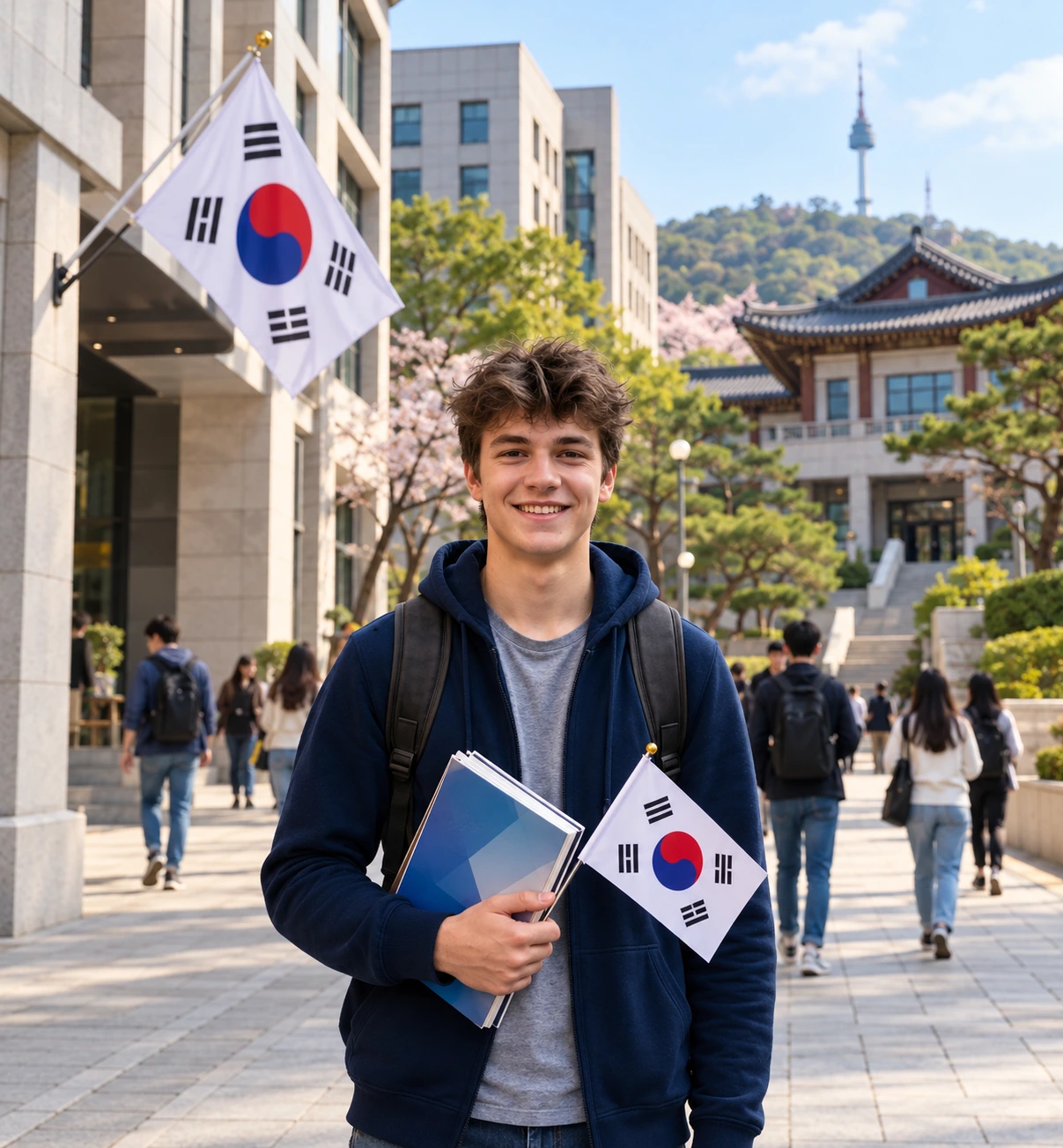
Key reasons to study in South Korea include:
Quality Education: Explore universities offering undergraduate, postgraduate, and research programs across diverse academic fields.
Technology and Innovation: Study in a country known for its technology, electronics, automotive, telecommunications, and digital industries.
Globally Oriented Programs: Find courses designed to prepare students for international careers and further academic development.
English-Taught Courses: Some universities offer programs taught in English, allowing eligible students to explore options without choosing a fully Korean-taught course.
Scholarship Opportunities: Eligible international students may apply for government-funded scholarships and university-specific financial assistance.
International Student Experience: Experience Korean culture, modern infrastructure, campus activities, and a diverse learning environment.
Research Opportunities: Explore academic and research pathways in engineering, natural sciences, biotechnology, artificial intelligence, and related disciplines.
The best university and course depend on your academic background, budget, language proficiency, and career goals.
Benefits of Studying in South Korea
Choosing South Korea for higher education can offer academic, personal, and professional benefits.
Advanced Technology and Research
South Korea is a strong option for students interested in technology-oriented education. Depending on the institution and program, students may have opportunities to explore research, laboratories, innovation projects, and industry-focused learning.
Wide Range of Academic Programs
International students can explore programs in engineering, computer science, business, finance, life sciences, design, media, humanities, and other disciplines. Course availability and admission requirements vary by university.
Scholarships for International Students
Scholarships may help eligible students manage their education expenses. Options include the Global Korea Scholarship (GKS), university scholarships, and other institution-specific funding opportunities. Each scholarship has its own eligibility criteria, application process, and deadlines.
Opportunities to Learn Korean
Learning Korean can help students adjust to everyday life, communicate more confidently, and explore additional academic or professional opportunities. Korean language proficiency may also be required for particular programs.
International Exposure and Personal Growth
Studying in another country helps students develop independence, communication skills, cultural awareness, and the ability to work with people from different backgrounds.
Popular Courses to Study in South Korea
South Korean universities offer a broad range of academic programs. The right course depends on your previous education, interests, and long-term career plans.
Popular fields to consider include:
- Computer Science and Information Technology
- Artificial Intelligence and Machine Learning
- Data Science and Analytics
- Mechanical and Electrical Engineering
- Electronics and Semiconductor Technology
- Business Administration and Management
- International Business and Finance
- Biotechnology and Life Sciences
- Chemistry and Materials Science
- Media, Film, and Communication
- Design and Creative Arts
- Korean Language and Cultural Studies
- Economics and International Relations
- Hospitality and Tourism Management
Before applying, check whether your preferred program is available in English or Korean and review its subject prerequisites, language requirements, and application deadlines.
Study in South Korea After 12th
Students who have completed Class 12 can explore undergraduate degree programs at South Korean universities. Admission requirements depend on the institution, course, academic record, and language of instruction.
Students should generally prepare for the following:
- Completion of Class 12 or an equivalent recognised qualification.
- Academic marksheets and school-leaving or graduation documents, as applicable.
- A valid passport.
- Proof of English or Korean language proficiency, where required.
- A personal statement or study plan, if requested.
- Letters of recommendation, if required by the university.
- Financial documents demonstrating the ability to cover study and living expenses.
- Any additional documents specified by the university or program.
Students applying for technical, science, or other specialised programs should also review subject-specific eligibility criteria.
Planning to study in South Korea after 12th?
to explore suitable programs, compare university requirements, and prepare your application documents.
Study in South Korea for Master’s and Postgraduate Programs
South Korea offers postgraduate study options for students who want to specialise in a subject, develop research skills, or prepare for international career opportunities.
Popular master’s-level fields include:
- MS in Computer Science
- MS in Artificial Intelligence and Data Science
- Master’s in Engineering
- Master’s in Business Administration (MBA)
- Master’s in International Business
- Master’s in Biotechnology
- Master’s in Finance and Economics
- Master’s in Materials Science
- Master’s in Media and Communication
Eligibility Requirements for Study in South Korea
Applicants typically need to meet the following requirements, subject to university and course-specific rules:
- A recognised bachelor’s degree relevant to the intended program.
- Academic transcripts and degree certificates.
- English or Korean language test results, where required.
- A statement of purpose, personal statement, or study plan.
- Letters of recommendation, if required.
- A CV or resume for applicable programs.
- Research proposal or portfolio for selected courses.
- Proof of financial resources.
- Additional documents requested by the university.
Some research-based programs may require students to identify a supervisor or submit a research proposal. Review the requirements carefully before submitting an application.
Top Universities to Consider in South Korea
South Korea has universities offering programs across engineering, technology, business, science, humanities, and other disciplines. Students should shortlist institutions according to their preferred subject, teaching language, budget, location, and admission profile.
Universities worth researching include:
Seoul National University: Offers a broad range of academic and research disciplines.
KAIST (Korea Advanced Institute of Science and Technology): Known for science, engineering, and technology-focused education.
POSTECH (Pohang University of Science and Technology): A university to consider for science, engineering, and research.
Yonsei University: Offers programs across multiple academic disciplines.
Korea University: Provides undergraduate and postgraduate study options in a range of fields.
Sungkyunkwan University (SKKU): Offers programs spanning technology, business, science, and the humanities.
Hanyang University: A potential option for students exploring engineering, technology, and other professional fields.
Kyung Hee University: Offers a variety of programs for local and international students.
Pusan National University: An option for students considering study outside Seoul.
Kyungpook National University: Offers programs across science, engineering, and other academic disciplines.
UNIST (Ulsan National Institute of Science and Technology): Worth considering for science, engineering, and technology-related study.
This list is a starting point, not a universal ranking. Program availability, English-language options, scholarships, and eligibility can vary by intake and department. Always verify details on the university’s official website.
Cost of Studying in South Korea
Understanding the cost of studying in South Korea is an important part of planning your international education. Your total budget will depend on the university, degree level, subject, city, accommodation, and lifestyle.
Estimated Tuition Fees
The following figures are national averages published on South Korea’s official Study in Korea portal. They are reference figures rather than guaranteed fees for a specific university or course.
| Study Level or Institution Type | Average Annual Tuition (KRW) | Average Annual Tuition (INR) |
| Undergraduate programs — national average | Approximately KRW 6.82 million | Approximately ₹4,88,994 |
| Undergraduate programs — national and public universities | Approximately KRW 4.27 million | Approximately ₹3,06,159 |
| Undergraduate programs — private universities | Approximately KRW 7.63 million | Approximately ₹5,47,071 |
| Graduate programs — national average | Approximately KRW 4.22 million | Approximately ₹3,02,574 |
Note: INR amounts are approximate conversions. Actual tuition fees vary by university, course, and academic year. Exchange rates may change.
Actual fees can be higher or lower depending on the institution and academic discipline. Professional and specialised programs may have different fee structures.
Estimated Monthly Living Expenses
The official Study in Korea portal provides an indicative monthly living-expense estimate of approximately KRW 750,000–1,000,000.
| Expense Category | Estimated Monthly Cost (KRW) | Estimated Monthly Cost (INR) |
| Accommodation | KRW 500,000–700,000 | ₹35,850–₹50,190 |
| Food | KRW 200,000–300,000 | ₹14,340–₹21,510 |
| Transportation | KRW 50,000–100,000 | ₹3,585–₹7,170 |
| Other Expenses | KRW 100,000–200,000 | ₹7,170–₹14,340 |
These categories are indicative and may not add up exactly to the stated overall estimate. Actual expenses depend on accommodation type, city, food choices, insurance, and personal spending. Seoul and other metropolitan areas may require a different budget from smaller cities.
Students should also budget for application fees, visa-related expenses, airfare, health insurance, books, deposits, and other initial costs.
Tip: Before selecting a university, compare the full cost of the course and living arrangements rather than tuition fees alone.
Scholarships to Study in South Korea
Scholarships can help eligible international students reduce their education expenses. South Korea offers government and university-level funding opportunities, but awards are competitive and eligibility varies.
1. Global Korea Scholarship (GKS)
The Global Korea Scholarship is a government scholarship program for eligible international students. Depending on the applicable scholarship category and current guidelines, it may provide support for approved study-related expenses.
Applicants must meet the relevant nationality, academic, age, program, and other conditions. The benefits, application routes, and deadlines depend on the scholarship category and year.
2. University Scholarships
Some universities provide scholarships based on academic performance, admission results, language proficiency, research activities, or other institutional criteria.
3. Merit-Based Scholarships
Eligible students may be considered for merit-based awards or tuition reductions, depending on the university’s scholarship policy.
4. Departmental or Research Funding
Selected postgraduate students may find funding opportunities through their department, research group, or academic supervisor. Availability depends on the program and institution.
How to Improve Your Scholarship Preparation?
- Maintain a strong academic record.
- Review the current scholarship guidelines carefully.
- Prepare a clear study plan or personal statement.
- Obtain recommendation letters where required.
- Meet all language and documentation requirements.
- Apply before the official deadline.
- Check whether the scholarship covers full tuition, partial tuition, living expenses, or other costs.
Scholarships are not guaranteed. Check current eligibility and benefits through official scholarship and university sources before making financial decisions.
English-Taught Programs and Korean Language Requirements
Students can find programs taught in English as well as programs taught in Korean. The language requirement depends on the university, degree, department, and specific intake.
Can You Study in South Korea in English?
Yes, some universities offer English-taught programs for international students. However, not every course or university offers an English-language option.
Before applying, confirm:
- Whether the entire program is taught in English.
- Whether IELTS, TOEFL, or another English proficiency test is required.
- Whether the university accepts alternative evidence of English proficiency.
- Whether a Korean language qualification is required for admission or graduation.
- Whether language requirements differ between undergraduate and postgraduate programs.
Do not assume that a university will waive an English test based on your previous education. Confirm the policy directly with the institution.
Is Korean Language Proficiency Necessary?
Korean proficiency can be important for Korean-taught courses and may be measured through the Test of Proficiency in Korean (TOPIK). Some English-taught programs may have different requirements.
Learning Korean can also help with daily communication, cultural adjustment, and exploring opportunities beyond the classroom.
Admission Process for Study in South Korea
Applying to South Korean universities involves several steps. Starting early gives you time to research programs, prepare documents, and meet the relevant deadlines.
Step 1: Profile Evaluation and Career Counselling
Review your academic background, preferred subject, budget, language proficiency, and future goals to identify suitable study options.
Step 2: University and Course Selection
Shortlist universities based on program availability, entry requirements, tuition fees, teaching language, location, and scholarship options.
Step 3: Document Preparation
Prepare the required academic documents, passport, language test results, study plan, personal statement, recommendation letters, and financial evidence as applicable.
Step 4: Application Submission
Complete the university application and submit all requested documents before the deadline. Some universities may require additional assessments or interviews.
Step 5: Admission Decision
The university evaluates your application and communicates its decision. If admitted, review the offer conditions, payment deadlines, and next steps.
Step 6: Financial Planning and Scholarship Applications
Confirm the tuition fee, accommodation costs, available funding, and financial evidence required for your student visa application.
Step 7: Student Visa Application
After receiving the relevant admission documents, prepare your visa application according to the applicable visa category and current embassy or consular instructions.
Step 8: Pre-Departure Preparation
Plan your accommodation, travel, insurance, arrival arrangements, and essential documents before travelling.
Yukon Overseas can help you understand these steps and organise your application process according to your selected university and study plan.
Documents Required to Study in South Korea
Document requirements vary by university, degree, scholarship, and visa category. Students should confirm the latest checklist before applying.
Academic Documents
- Class 10 and Class 12 marksheets and certificates, where applicable.
- Bachelor’s degree certificate and transcripts for postgraduate applicants.
- Other previous academic records requested by the institution.
- Official translations or authentication, if required.
Personal and Application Documents
- Valid passport.
- Passport-size photographs.
- Completed university application forms.
- Statement of purpose, personal statement, or study plan.
- Letters of recommendation, where required.
- Updated CV or resume, where applicable.
- English or Korean language proficiency results, if required.
- Portfolio or research proposal for selected programs.
Financial Documents
- Bank statements or other accepted proof of funds.
- Sponsorship documents, if applicable.
- Proof of scholarship or financial support, where relevant.
- Additional documents required by the university or visa authorities.
The university and the Korean diplomatic mission handling your application may request additional documents. Ensure that all information is accurate and consistent across your application.
Student Visa for South Korea
International students generally need the appropriate visa to study in South Korea. The correct category depends on the purpose and type of study.
D-2 Student Visa
The D-2 category is generally used by international students enrolling in eligible degree programs, including bachelor’s, master’s, and doctoral studies, as well as certain other recognised academic programs.
D-4 Training Visa
The D-4 category generally covers eligible non-degree training programs, including certain Korean language training courses. The correct subcategory depends on the institution and purpose of study.
General Student Visa Application Steps
1. Secure admission to an eligible institution or program.
2. Obtain the required admission documents from the institution.
3. Review the visa category and current document checklist.
4. Prepare your passport, photographs, education documents, and proof of financial ability.
5. Complete the relevant visa application.
6. Submit the application to the appropriate Korean diplomatic mission or through the designated process.
7. Provide any additional documents or attend an appointment if requested.
8. Wait for the visa decision before finalising your travel arrangements.
Important Visa Considerations
Visa requirements, financial evidence, processing arrangements, and supporting documents can change. The final checklist depends on your circumstances and the relevant Korean diplomatic mission.
Admission to a university does not guarantee visa approval. Always check the latest official instructions before applying.
Yukon Overseas can guide students in understanding the application process, organising supporting documents, and preparing for the next steps.
Work Opportunities While Studying in South Korea
Some international students may be permitted to undertake part-time work while studying in South Korea. Permission and eligibility depend on the student’s visa status, course, language ability, institution, and applicable immigration rules. Students should not assume that they can begin working immediately after arrival.
Before accepting employment, confirm:
- Whether your visa category permits the intended work.
- Whether prior permission or authorisation is required.
- The permitted working hours and any restrictions.
- Whether your university must approve or support the application.
- The conditions applicable to your specific course and immigration status.
Part-time work should not be treated as a guaranteed way to cover all tuition fees and living expenses. Students should arrange sufficient funding for their studies before travelling.
Career Opportunities After Studying in South Korea
South Korea has established industries across technology, manufacturing, research, business, and creative sectors. Graduates may explore career opportunities according to their qualifications, skills, language ability, and employment eligibility.
Potential career fields include:
- Information Technology and Software Development
- Artificial Intelligence and Data Analytics
- Engineering and Advanced Manufacturing
- Electronics and Semiconductor Technology
- Business Administration and International Trade
- Finance and Business Analysis
- Biotechnology and Life Sciences
- Research and Development
- Media, Communication, and Creative Industries
- Logistics and Supply Chain Management
Career opportunities depend on the student’s field of study, experience, employer requirements, Korean language proficiency, and applicable immigration rules.
Students who want to work in South Korea after graduation should research the relevant employment visa options and eligibility conditions well before completing their course. A degree does not automatically provide the right to work or remain in the country.
Best Cities to Study in South Korea
Choosing the right city is an important part of selecting a university. Consider your course, budget, lifestyle, accommodation options, and access to relevant industries.
Seoul
Seoul is the capital and a major centre for education, business, technology, culture, and international student life. It offers a wide range of universities and academic programs, although living expenses may be higher than in some other cities.
Busan
Busan is a major coastal city with universities, cultural attractions, and industries connected to trade, logistics, and maritime activities.
Daejeon
Daejeon is worth considering for students interested in science, engineering, technology, and research-focused education.
Daegu
Daegu offers university options across several academic disciplines and may suit students comparing study opportunities outside the capital.
Incheon
Incheon is a major city near Seoul with educational institutions, transport links, and business activity. Compare individual universities and commuting arrangements when considering this location.
The best city for you will depend on your university offer, total budget, and academic goals.
Why Choose Yukon Overseas for Study in South Korea?
Planning to study abroad involves important decisions about universities, course selection, applications, finances, and visa requirements. Yukon Overseas supports students as they explore their international education options.
Our support may include:
Profile Evaluation and Counselling: Understand your academic background, preferences, and study goals.
University and Course Shortlisting: Explore programs that match your qualifications, interests, and budget.
Application Assistance: Organise university applications and supporting documents.
SOP and Documentation Guidance: Understand how to prepare the documents requested by your chosen institution.
Scholarship Guidance: Identify relevant scholarship opportunities and review their eligibility criteria.
Student Visa Guidance: Understand the applicable visa category and organise supporting documentation.
Pre-Departure Guidance: Prepare for accommodation, travel, and the transition to student life abroad.
Every student’s profile is different. Our aim is to help you make informed decisions and approach your South Korea study plan with greater clarity.
Start Your Study in South Korea Journey Today
South Korea offers opportunities to explore technology, engineering, business, research, and many other academic fields in an international learning environment. With careful planning, the right university selection, and complete documentation, you can take a confident step towards your higher education goals. If you are planning to study in South Korea after 12th or pursue a master’s degree, Yukon Overseas can help you understand your options and prepare for the next steps. Contact Yukon Overseas today for FREE counselling and start planning your study in South Korea journey.
Frequently Asked Questions
South Korea can be a suitable destination for Indian students interested in technology, engineering, business, science, research, and Korean culture. The right choice depends on your academic goals, budget, preferred course, and language requirements.
Yes. Eligible students can apply for undergraduate programs after completing Class 12 or an equivalent qualification. Admission requirements depend on the university, program, academic record, and language proficiency.
Popular fields include computer science, artificial intelligence, engineering, business management, biotechnology, data science, media studies, and international business. Course availability varies by institution.
Yes. Some South Korean universities offer English-taught programs. Students should verify the teaching language and English proficiency requirements of their chosen course before applying.
IELTS is not a universal requirement for every program. Some universities may accept other English proficiency tests or alternative evidence, while others have specific test requirements. Confirm the policy with the university.


